

There is a number on your Synergy bill that quietly decides whether your solar system is a good investment or a mediocre one. It isn’t the size of your array. It isn’t the brand of your panels.
It’s the share of your solar power that leaves your property.
From 1 July 2026, Synergy charges Western Australian households 33.2621 cents per unit on the standard Home Plan (A1), plus a daily supply charge of $1.1924. For most of the day, Synergy pays you 2 cents for the solar you send back.
That is not a rounding difference. Every kilowatt-hour you export instead of use is worth one-sixteenth of what it would have been worth staying home.
What DEBS actually pays
Western Australia’s Distributed Energy Buyback Scheme (DEBS) has replaced the old net metering arrangements for anyone connecting solar since September 2020. It pays two rates:
| Time of day | What Synergy pays you | What Synergy charges you | Difference |
|---|---|---|---|
| 3pm – 9pm (“peak”) | 10c/kWh | 33.26c/kWh | –23.26c |
| 9pm – 3pm (everything else) | 2c/kWh | 33.26c/kWh | –31.26c |
Payments apply to the first 50 units exported per day, and they’re based on net export – power that leaves your property after your home has taken what it needs.
Read that table again, because it contains an uncomfortable truth: even the good rate is a bad trade. When you export at 3pm for 10 cents, you are selling energy you will buy back at 6pm for 33.26 cents. You’ve lost 23 cents on a round trip that took three hours.
The off-peak rate is worse. Between 9am and 3pm – the six hours when your roof is producing almost everything it will produce all day – you are paid 2 cents.
The timing problem often forgotten at the quote stage
Solar generation in Perth is a bell curve. It starts around 7am, peaks hard between 11am and 2pm, and fades to nothing by about 5:30pm in winter.
Household demand is the opposite shape. There’s a small spike at breakfast, a long flat trough while everyone is at work or school, and then a wall of consumption from about 4pm: air conditioning, ovens, showers, washing machines, televisions, and increasingly an EV on the charger.
The two curves barely overlap. Without storage, a typical Perth home with nobody there during the day self-consumes somewhere between 20% and 35% of what its panels make. The rest goes to the grid at 2 cents – and then the household buys it straight back a few hours later at 33.26.
This is the entire problem in one sentence: your roof produces at noon, your family consumes at six, and the grid charges you sixteen times more to bridge the gap than it pays you to create it.
What that gap looks like in real dollars
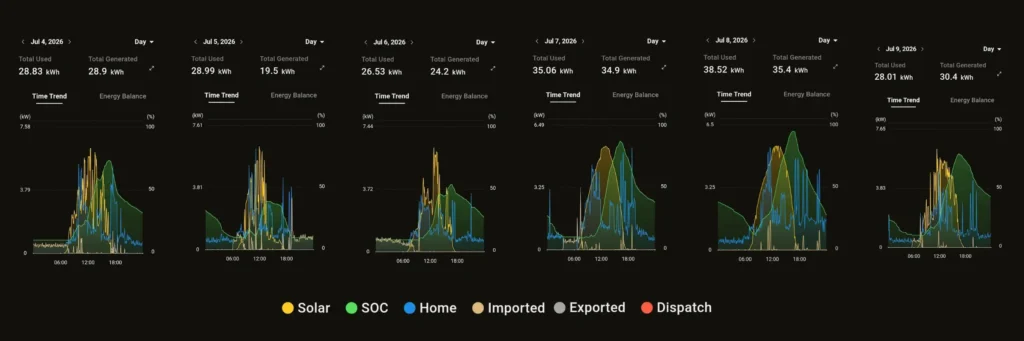
We don’t have to theorise about this. We published six days of live data from a real Perth system earlier this year – a Churchlands home running an AlphaESS Smile G3 S5 with 21.16 kWh of storage, configured for self-consumption.
Across six days in July, that system generated 173.3 kWh while the household consumed 185.94 kWh. Solar covered about 93% of everything the home used.
Now run those same 173.3 kWh through the two possible fates:
- Exported off-peak at 2c: 173.3 × $0.02 = $3.47
- Used in the home, displacing grid power at 33.26c: 173.3 × $0.332621 = $57.64
Same panels. Same sunshine. Same week. A difference of $54.17 – over six days.
Annualise that and you’re looking at roughly $3,300 a year riding on nothing but the question of where the electrons go.
No real home sits at either extreme. Nobody exports 100%, and nobody self-consumes 100%. But that $3.47-to-$57.64 spread is the range every WA solar owner is operating somewhere inside – and the closer you sit to the top of it, the better your system performs.
(You can read the full six-day breakdown, including the overcast Saturday where the battery only reached 40%, in Six Days on Sunshine.)
The research backs this up – and it’s more specific than you’d expect
This isn’t just a WA installer’s talking point. It’s a well-documented finding in energy economics.
A December 2025 working paper from Kenneth Gillingham – Grinstein Professor of Environmental & Energy Economics at Yale and Senior Associate Dean at the Yale School of the Environment – and colleagues at Michigan State and Dartmouth modelled what happens to households when a government cuts the rate paid for exported solar. (Gillingham’s Yale profile)
Their finding is the useful part. The financial damage of a low export rate scales almost entirely with how much of your generation you export. In their modelling, households exporting essentially none of their solar were unaffected by the cut. Households exporting nearly all of it saw the value of their system fall by up to 23%.
The rate itself wasn’t the variable that mattered most. Your export share was.
That study looked at California, where the electricity pricing structure is quite different to ours, so the specific numbers don’t transfer to Perth. But the mechanism does – and in Western Australia, where the gap between the import price and the off-peak export price is one of the widest in the country, it applies with more force here than it did there.
The same research also found that households mentally discount future savings far more heavily than the finance models used in solar quotes assume – which is worth knowing when you’re comparing a system that saves you money every single day against one that trickles credits back at 2 cents.
Why WA’s rebates are structured the way they are
There’s a second finding in that paper worth a moment.
The researchers compared two ways for a government to support solar: paying households an ongoing rate for exported power, or paying them a lump sum upfront to install. Upfront subsidies won on both counts – better value for public money, and better outcomes for lower-income households, who are dramatically more sensitive to the purchase price than to long-run returns.
Which is, more or less, the model Western Australia now runs. Low export rates, substantial money upfront:
- The federal battery rebate, delivered through STCs, still applies – though the STC factor stepped down from 8.4 to roughly 6.8 from 1 May 2026, and now applies at full value only to the first 14 kWh of capacity, at 60% between 14 and 28 kWh, and at 15% from 28 to 50 kWh.
- The WA Residential Battery Scheme remains separate and can still be stacked with the federal rebate, subject to eligibility including Virtual Power Plant participation.
We’ve covered the detail of the May 2026 changes in How the May 2026 Rebate Changes Affect Battery Installations in WA, and current amounts are on our Government Grants page.
The policy is telling you something. WA isn’t paying you to send power to the grid. It’s paying you to keep it.
What this changes about how your system should be designed
Once you accept that self-consumption is where the value sits, several standard assumptions stop making sense.
Battery capacity should be sized to your evening load, not to your roof. The Churchlands system works because 21.16 kWh happened to match what that household draws from sunset to sunrise. A battery larger than your overnight demand sits half-empty; one smaller runs flat at 2am and hands you back to the grid at full price.
Daytime occupancy is worth real money. A home office, a retiree, someone home with kids – every load you can move into daylight hours is a kilowatt-hour bought at 0c instead of sold at 2c.
Shiftable loads should be shifted. Pool pumps, hot water systems, dishwashers and washing machines are the easiest wins in the house. Running the pool pump at 11am instead of 8pm is a 31-cent swing on every unit it draws.
EV charging belongs in the middle of the day. If you can charge at home on solar rather than overnight on grid power, the economics of the car change entirely – we’ve written about that in Tired of $2.60 Petrol?.
Export what’s genuinely spare, into the peak window. A battery lets you do something a bare solar system can’t: cover your own evening load first, then send any true surplus out between 3pm and 9pm at 10c rather than 2c. It’s the lowest-value use of a battery, but it beats giving it away at breakfast rates.
The rough numbers on a battery
A 10 kWh usable battery, cycling once a day at around 90% round-trip efficiency, delivers roughly 9 kWh into the house each evening.
Those 9 kWh would otherwise have been exported at 2c (worth 18c) and bought back at 33.26c (costing $2.99). The battery captures the difference: about $2.81 a day, or roughly $1,025 a year.
Scale that to the 21.16 kWh system in Churchlands and, on days with enough sun and enough evening load to use it, the figure roughly doubles.
Those numbers assume you have the surplus to charge it and the evening demand to discharge it. Not every home does – which is exactly why we model your actual consumption data before quoting a capacity, rather than working backwards from a rebate threshold.
The short version
Synergy will pay you 2 cents for solar you don’t use, and charge you 33.26 cents for power you do. Every design decision in a WA solar system should follow from that single fact.
Panels create the energy. What you do with it between noon and six determines what it’s worth.
If you’d like us to look at your actual usage data and model what self-consumption is realistically achievable at your place, get in touch. We’ll show you the numbers before we show you a quote.
Rates quoted are Synergy Home Plan (A1) residential tariffs effective 1 July 2026 and current DEBS buyback rates. Prices are set annually by the WA Government and are subject to change. Rebate levels and eligibility criteria change periodically – confirm current amounts before making a purchase decision.
Sources:
- Household electricity pricing – Energy Policy WA
- Distributed Energy Buyback Scheme – Synergy
- Energy buyback schemes – Energy Policy WA
- Gillingham, K., Kirkpatrick, A.J., and Bollinger, B., “Valuing Solar Subsidies,” working paper, December 2025
About the Author

Darren Magennis Head of Operations DMG Solar & Electrical
Licensed electrician with over 17 years’ experience in solar power, electrical installations, and residential energy management across Western Australia. Darren has been designing and installing solar and energy systems since 2014, and cofounded DMG Solar in 2021 to bring that experience directly to WA homeowners.

Ready to Get Started?
Drop us a line or fill out our quote form and we will be in touch for an obligation free Quote
DMG Solar & Battery Services
DMG Solar provides a superior service which overall adds value to your property.


Join Thousands of WA HomeownersBook Your Free Consultation
See why more families are choosing DMG Solar for trusted installations.
Trusted by TheLeading Brands