

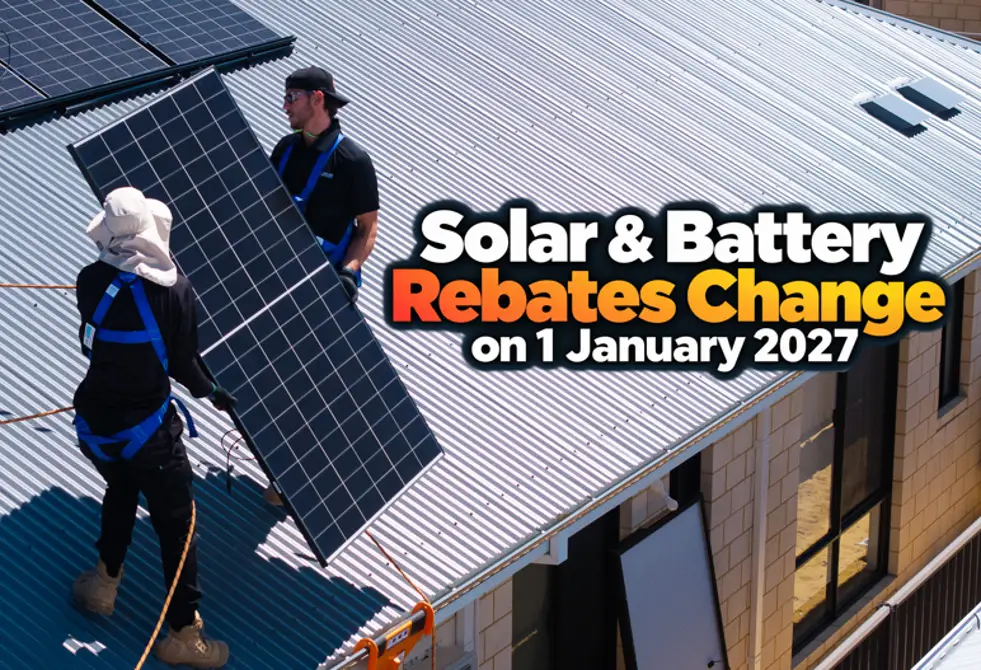
On 1 January 2027, both federal rebates that reduce the upfront cost of solar panels and home batteries are scheduled to step down. The WA Government’s battery rebate isn’t changing on that date.
If you’re weighing up solar, a battery or both, this article covers what’s changing, roughly how much it’s worth, and why it pays to get your quote organised well before the end of the year.
What’s Changing and When
| Incentive | Run by | What happens on 1 January 2027 |
|---|---|---|
| Cheaper Home Batteries Program | Federal Government | Battery rebate drops by about 16% per kWh |
| Solar panel STCs (Small-scale Renewable Energy Scheme) | Federal Government | Solar rebate drops by about 20% |
| WA Residential Battery Scheme | WA Government | No scheduled change |
| Distributed Energy Buyback Scheme (DEBS) | WA Government | No change – rates are reviewed each 1 July |
Both federal rebates are paid through Small-scale Technology Certificates (STCs). When you buy a system, your installer claims the STCs for you and takes their value off your price, so the discount comes off at the point of sale rather than as money back later.
The Federal Battery Rebate (Cheaper Home Batteries Program)
The number of STCs a battery earns is set by its usable capacity multiplied by a figure called the STC factor. The factor is 6.8 for batteries installed now, and it drops to 5.7 for batteries installed from 1 January 2027.
The size-based tiers introduced in May 2026 stay in place. If you missed those changes, we covered them in How the May 2026 Rebate Changes Affect Battery Installations in Western Australia. In short:
- The first 14 kWh of usable capacity receives the full STC factor
- Capacity from 14 to 28 kWh receives 60% of the factor
- Capacity from 28 to 50 kWh receives 15% of the factor
After January, the factor keeps dropping every six months until the scheme ends in 2030:
| Installed between | STC factor per kWh |
|---|---|
| 1 May – 31 December 2026 | 6.8 |
| 1 January – 30 June 2027 | 5.7 |
| 1 July – 31 December 2027 | 5.2 |
| 1 January – 30 June 2028 | 4.6 |
| 1 July – 31 December 2028 | 4.1 |
| 1 January – 30 June 2029 | 3.6 |
| 1 July – 31 December 2029 | 3.1 |
| 1 January – 30 June 2030 | 2.6 |
| 1 July – 31 December 2030 | 2.1 |
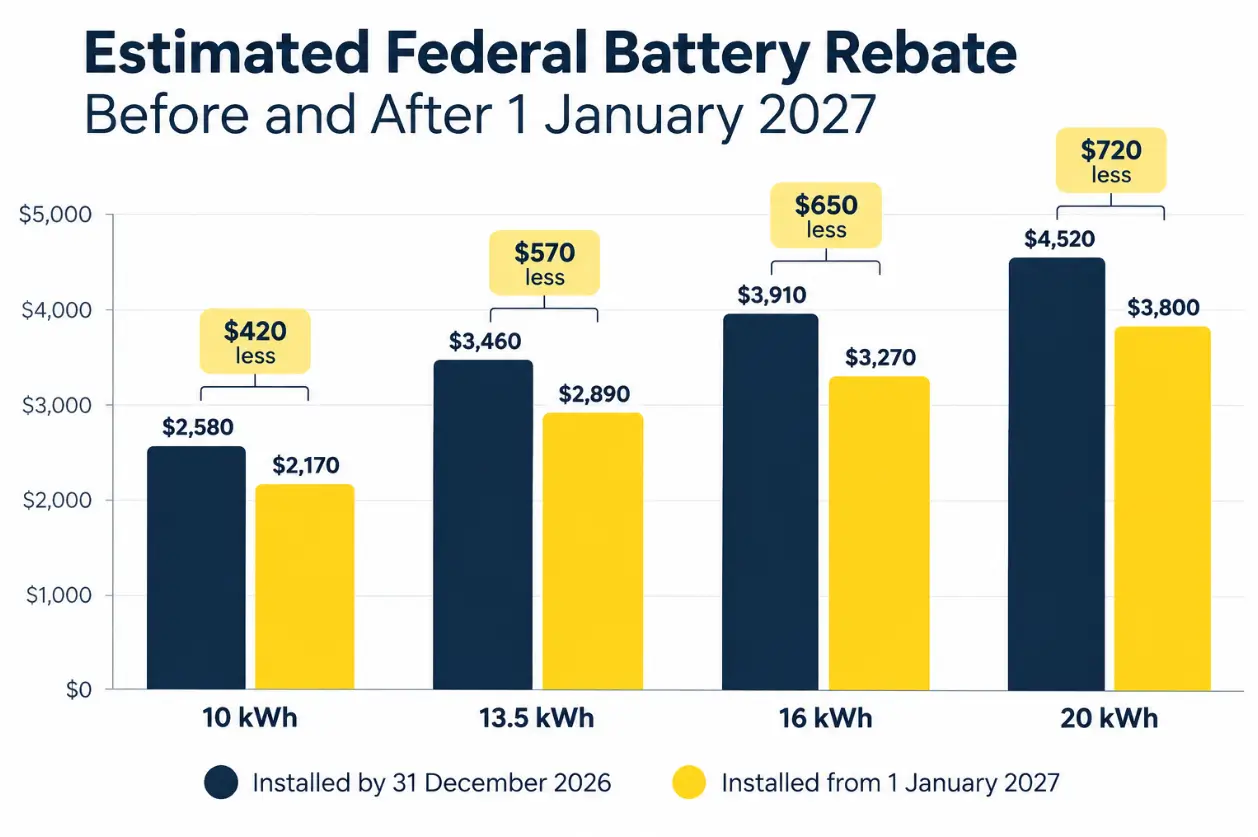
Estimated Federal Battery Rebate Before and After 1 January 2027
| Usable battery size | Installed by 31 Dec 2026 | Installed from 1 Jan 2027 | Difference |
|---|---|---|---|
| 10 kWh | About $2,580 | About $2,170 | About $420 less |
| 13.5 kWh | About $3,460 | About $2,890 | About $570 less |
| 16 kWh | About $3,910 | About $3,270 | About $650 less |
| 20 kWh | About $4,520 | About $3,800 | About $720 less |
You can check the number of STCs for a specific battery using the Clean Energy Regulator’s solar battery STC calculator.
The Federal Solar Panel Rebate
Solar panels earn STCs based on system size, location and a “deeming period”, which is the number of years of generation the rebate covers. The deeming period drops by one year every 1 January until the scheme ends in 2030. It’s five years for systems installed in 2026 and falls to four years from 1 January 2027.
This change has been scheduled since the scheme was set up, but it still makes a noticeable difference. For homes in Perth, it works out to roughly:
| Solar system size | Installed by 31 Dec 2026 | Installed from 1 Jan 2027 | Difference |
|---|---|---|---|
| 6.6kW | About $1,710 | About $1,370 | About $340 less |
| 10kW | About $2,620 | About $2,090 | About $530 less |
| 13.2kW | About $3,460 | About $2,740 | About $720 less |
If you already have solar and are only adding a battery, this part doesn’t affect you. See our residential solar systems page for more on system sizing.
The WA Residential Battery Scheme – What’s Staying the Same
The WA Government’s rebate isn’t scheduled to change on 1 January. It sits on top of the federal rebate:
- Synergy customers: $130 per kWh, up to $1,300
- Horizon Power customers: $380 per kWh, up to $3,800
- The rebate is capped at 10 kWh, so larger batteries receive the same maximum
- You’ll need to join a virtual power plant (VPP) through your retailer
- Households with a combined income under $210,000 may be eligible for a no-interest loan of up to $10,000
One thing to keep in mind is that the state scheme is limited to 100,000 rebates, and the WA Government says it’s currently expected to be available until 2027. Once the rebates are used up, the scheme may close. More detail on both federal and state incentives is on our government grants page.
What It Could Look Like for a Typical Perth Home
Here’s how the combined rebates compare for a Synergy customer installing solar and a battery together:
| System | Installed by 31 Dec 2026 | Installed from 1 Jan 2027 | Difference |
|---|---|---|---|
| 6.6kW solar + 13.5kWh battery | About $6,470 | About $5,560 | About $910 less |
| 10kW solar + 16kWh battery | About $7,840 | About $6,660 | About $1,180 less |
These totals include the federal solar rebate, the federal battery rebate and the $1,300 WA rebate.
Why Timing Matters
The rebate is based on the date your system is installed, not the date you sign your quote. A system quoted in November but installed on 4 January will receive the lower 2027 rate.
Spring and summer are the sunniest months of the year in Perth, and they’re also our busiest period for installations. Add the Christmas and New Year break, and the number of installation days left before 31 December shrinks quickly.
Do You Need to Rush?
You don’t need to rush into a decision. But if you’d like to access the current rebate levels, you’re much better off arranging a quote now and organising your installation before the end of the year, rather than leaving it until December.
We book out over this period, and we’d hate for anyone to miss the 2026 rates simply because there wasn’t an installation slot left before the deadline. Requesting a quote now gives us time to measure up and right-size a system around how your household uses power, then lock in an installation date with plenty of breathing room.
Right-sizing matters more than ever with the tiers in place. Because support per kWh drops after the first 14 kWh, a bigger battery isn’t always better value, and we’ll design your system around what makes sense for your home.
If you’re not ready yet, there will still be rebates worth having in 2027. If solar or a battery is already on your list, though, installing before 31 December could save you anywhere from a few hundred dollars to over a thousand, and it makes sense to take advantage of that.
Key Points for WA Homeowners
- The federal battery rebate drops by about 16% per kWh on 1 January 2027, then every six months after that
- The federal solar panel rebate drops by about 20% on 1 January 2027, then again each January until 2030
- The WA Residential Battery Scheme isn’t changing on that date, but it’s limited to 100,000 rebates
- Rebates are based on the installation date, not the quote date
- Installers book out over the summer months, so request your quote early to secure a date before 31 December
Talk to a West Australian Owned and Operated Team
DMG Solar is West Australian owned and operated, and other solar companies across WA trust us to install their systems. If you’d like to make the most of the current rebates, the best next step is to request a quote now. We’ll measure up, recommend a system that suits your home, and book your installation in with time to spare before the January change.
Learn more about our home battery installation service, reach out on (08) 6185 0478 or request a quote and we’ll be in touch.
Figures are estimates based on an STC value of around $38 and a Perth (zone 3) location for solar. STC prices move with the market, and your quote will show the exact rebate for your system. Information is current as of September 2026 and is based on published Federal and WA Government program details.
References
- Federal Register of Legislation – Renewable Energy (Electricity) Amendment, battery STC factor schedule
- Clean Energy Regulator – Changes to the rebate for solar batteries
- Clean Energy Regulator – Deeming period decline
- Department of Climate Change, Energy, the Environment and Water – Cheaper Home Batteries Program
- Western Australian Government – WA Residential Battery Scheme
About the Author
Darren Magennis Head of Operations DMG Solar & Electrical
Licensed electrician with over 17 years’ experience in solar power, electrical installations, and residential energy management across Western Australia. Darren has been designing and installing solar and energy systems since 2014, and cofounded DMG Solar in 2021 to bring that experience directly to WA homeowners.

Ready to Get Started?
Drop us a line or fill out our quote form and we will be in touch for an obligation free Quote
DMG Solar & Battery Services
DMG Solar provides a superior service which overall adds value to your property.


Join Thousands of WA HomeownersBook Your Free Consultation
See why more families are choosing DMG Solar for trusted installations.
Trusted by TheLeading Brands